
Orbit Claims Single-Node RL Post-Training for Trillion-Parameter AI Models
The open-source framework freezes low-precision base models and trains only BF16 adapters, aiming to make RL post-training cheaper, simpler, and closer to deployment behavior.

Reinforcement learning has become one of the key ingredients behind stronger reasoning, coding, math, and tool-use abilities in modern AI models. But once a model reaches trillion-parameter MoE scale, RL post-training stops being just an algorithm problem.
It becomes a systems problem.
SphereLab has now open-sourced Orbit, an RL post-training framework designed around a very practical goal: make trillion-parameter model RL fit on a single GPU node.
According to SphereLab’s blog and GitHub repository, Orbit has been used to run stable end-to-end RL on Kimi-K2.6, DeepSeek V4-Flash, DeepSeek V4-Pro, and Qwen3 MoE models. The headline claim is striking: 1T-class models can fit on one 8×B200 node, while DeepSeek V4-Pro at around 1.6T parameters can also be validated in a single-node setup.
This does not mean training frontier models suddenly becomes cheap. An 8×B200 server is still a serious piece of infrastructure. But compared with multi-node RL systems, the simplification is meaningful: fewer synchronization problems, fewer failure points, less cross-node communication, and a training path that more closely matches the model’s eventual deployment setup.
The Core Trick: Freeze the Base, Train the Adapter
Traditional RL post-training at large scale can require enormous memory for model weights, gradients, optimizer states, rollout workers, and reference policies. For trillion-parameter MoE models, the memory budget can quickly exceed what a single machine can hold.
Orbit’s design takes a different path.
Instead of updating the full model, Orbit freezes the base model at deployment precision, such as INT4 or FP4, and trains only a small BF16 adapter, such as OFT or LoRA. In plain English: keep the giant model mostly fixed, then teach it through a lightweight trainable layer.
That adapter-first design is what lets Orbit squeeze trillion-scale RL into a single-node memory budget.
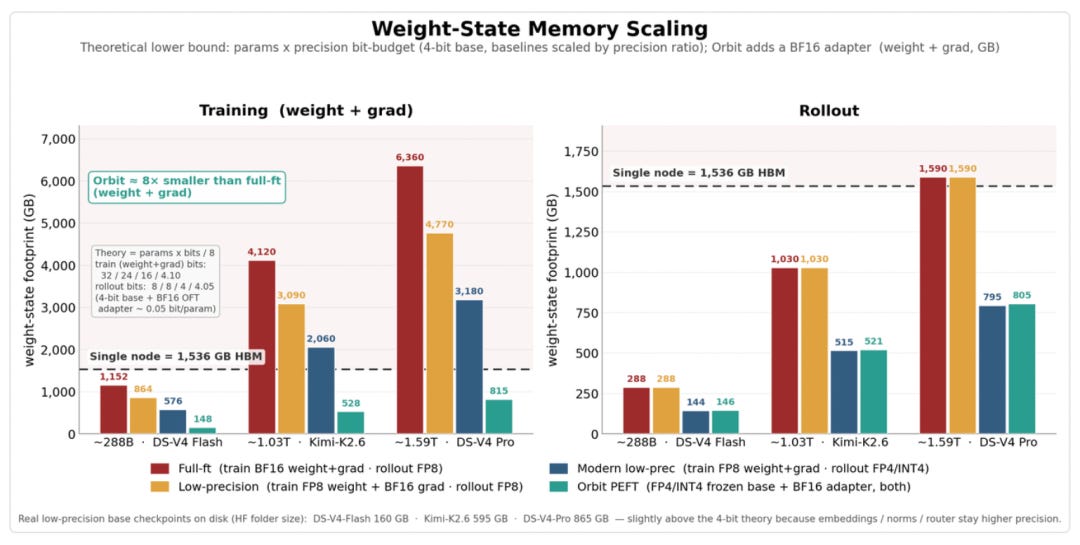
The GitHub README describes Orbit as a framework “built around low-precision bases and BF16 adapters” so that frontier-scale RL fits on a single node. It is released under Apache 2.0, with public code, examples, and launchers.
Why Precision Alignment Matters
One of Orbit’s most interesting ideas is not just memory saving. It is precision alignment.
In many RL systems, the training side may use one precision format, while rollout or serving uses another. That mismatch can be tolerable in supervised fine-tuning, where the model is simply learning from fixed targets. But RL is more delicate.
In RL post-training, policy log-probabilities are part of the training signal. If the training model and rollout model disagree because they use different precision paths, the training signal itself can drift.
Orbit tries to remove that gap by using the same low-precision base plus adapter path for training, rollout, and deployment. The result is a smaller train-rollout log-prob difference and a system that is easier to reason about.
This is the part that makes Orbit more than “LoRA for giant models.” It is a full systems design around low-precision RL.
Kimi-K2.6 and DeepSeek V4 Results
The Chinese source article highlights three experiments.
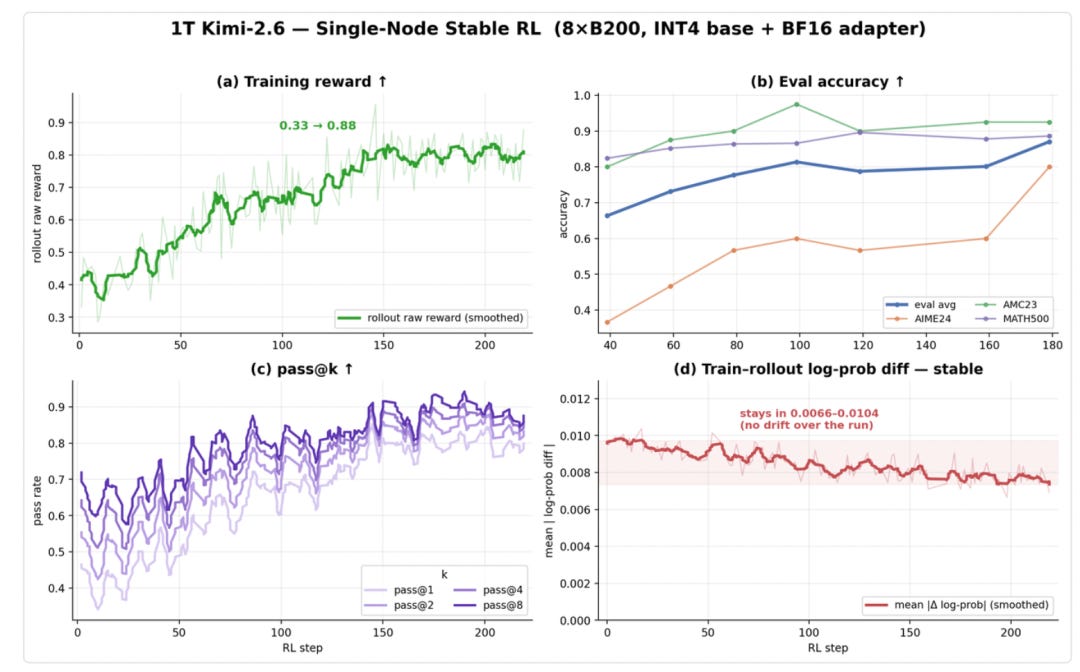
First, Orbit reportedly runs RL post-training on Kimi-K2.6, a roughly 1T model, on a single 8×B200 node using an INT4 base and BF16 adapter. Over about 200 RL steps, reward, eval accuracy, and pass@k improved, while the train-rollout log-prob difference stayed stable.
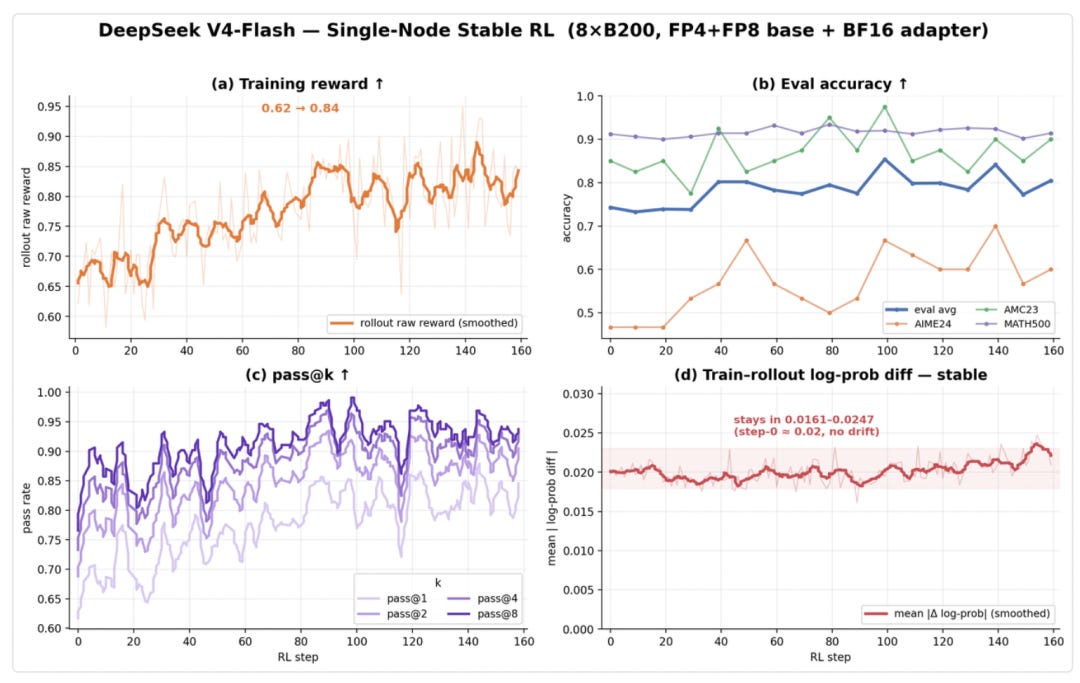
Second, DeepSeek V4-Flash was tested on the same single-node setup, using an FP4/FP8 base plus BF16 adapter. The reported curves show reward, eval metrics, and pass@k rising across more than 100 RL steps, again with stable train-rollout log-prob differences.
Third, Orbit was tested on DeepSeek V4-Pro at around 1.6T parameters. SphereLab frames this more as a systems validation than a benchmark win: the base model was already strong, so the RL data used in the experiment did not meaningfully raise scores. But the system still showed stable memory behavior and stable train-rollout log-prob difference on a single 8×B200 node.
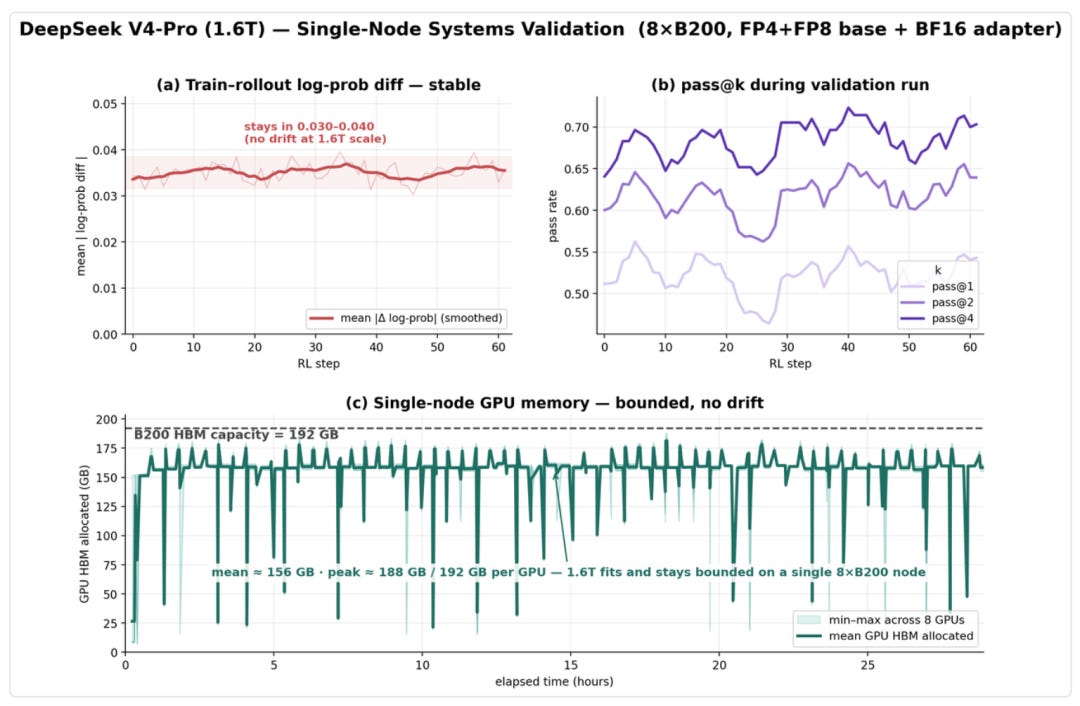
These are source-reported results, not independent third-party benchmarks. Still, the direction is important.
Why This Matters
RL post-training is becoming a major competitive frontier. DeepSeek-R1 made the industry pay attention to reasoning RL. Since then, the bottleneck has shifted from “can RL improve reasoning?” to “can labs run RL efficiently, repeatedly, and safely at large scale?”
Orbit’s answer is to make the system smaller.
If trillion-scale RL can run on one machine, iteration becomes easier. Debugging becomes easier. Failures become less catastrophic. Adapter synchronization is cheaper than full-model synchronization. And smaller labs may get access to techniques that previously required a large distributed cluster.
For smaller models, the same design may be even more practically useful. If the base model stays frozen and only the adapter is trained, a single GPU could support larger batches, longer responses, more rollout throughput, or more frequent policy updates than before.
This is why Orbit’s value is not only about “training a 1T model.” It is about making RL post-training more modular.